Why the Frankfurt Kitchen Became the Template for Modern Domestic Life
A 1926 blueprint for cutting a housewife's steps became the ancestor of every fitted kitchen since — and quietly wrote a gendered division of labor into the architecture of the home.
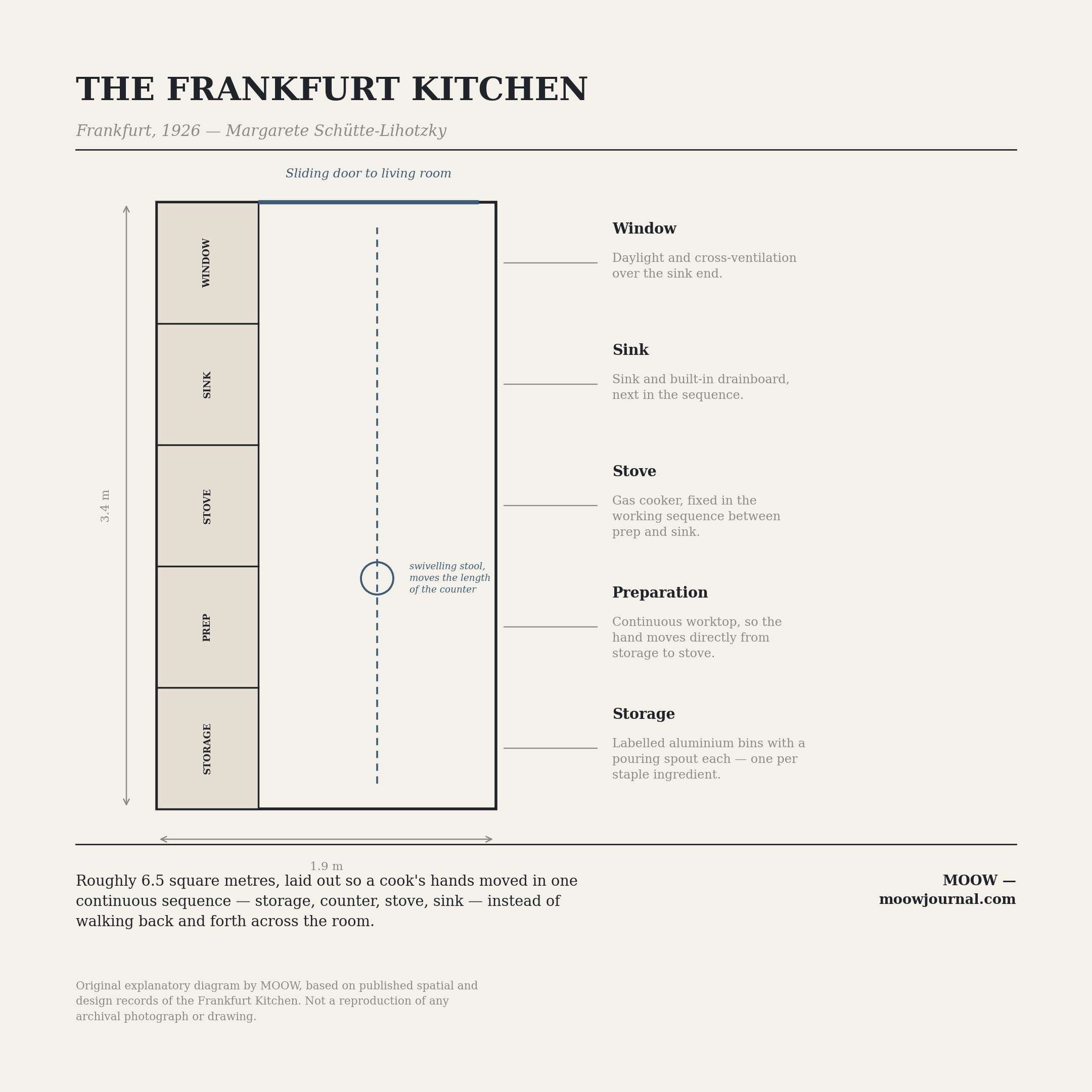
The Frankfurt Kitchen imported industrial efficiency into the home, standardizing the compact fitted kitchen we still live with today — while also isolating domestic work, and the people who did it, inside a room engineered for one body at a time.
Today’s kitchens often stand as a testament to sleek, efficient design, where culinary tasks are streamlined, every tool has its place, and surfaces are designed for easy maintenance. This familiar setup has its roots in an innovation from nearly a century ago: the Frankfurt Kitchen. Designed by architect Margarete Schütte-Lihotzky in the late 1920s, the Frankfurt Kitchen was part of a broader movement to transform domestic spaces into sites of industrial-like efficiency.
At a glance, the Frankfurt Kitchen seems to be about saving space in smaller living environments. However, this design carries a deeper narrative that delves into societal shifts of its time. It wasn’t merely about adapting to compact apartment living; it was a deliberate effort to introduce the principles of industrial efficiency into the domestic sphere. This leads us to an intriguing inquiry: how did this focus on efficiency reshape the kitchen into a gendered workspace?
Margarete Schütte-Lihotzky’s vision for the Frankfurt Kitchen was groundbreaking. Created as part of the New Frankfurt housing program, her design aimed to reduce the burdensome nature of housework, which was predominantly managed by women. Schütte-Lihotzky applied the efficiency principles seen in factories to the home, seeking to simplify and streamline domestic chores. The kitchen’s compact layout, complete with integrated storage and workspaces, was designed to minimize unnecessary movement and effort.
The impact of Schütte-Lihotzky’s design is well documented. Institutions like the Museum of Modern Art have showcased how the Frankfurt Kitchen translated industrial methodologies into household settings. Its integrated features prefigured the fitted kitchen models we recognize today, marking it as a significant milestone in the history of domestic design. Yet, while the kitchen was intended to liberate women by making housework more efficient, it inadvertently reinforced traditional gender roles. The kitchen evolved into a solitary workspace, often isolating women from the rest of the household.
The implications of the Frankfurt Kitchen’s design are still felt in contemporary homes. It established a standard for the efficient, fitted kitchen that continues to be a mainstay in compact urban apartments and open-plan living areas. This design choice standardized not only the physical space but also the social dynamics within it, underscoring efficiency and reinforcing the idea of the kitchen as a site of unpaid labor.
Exploring the legacy of the Frankfurt Kitchen offers a new lens through which to view our modern domestic environments. What often appears as mere design efficiency is actually a reflection of deeper social constructs and historical transitions. As we continue to navigate contemporary living arrangements, the story of the Frankfurt Kitchen invites us to reconsider how design decisions shape not just our physical spaces, but also our lives and interactions within them.
The enduring influence of the Frankfurt Kitchen is evident in the way it set the stage for modern kitchen design. By emphasizing efficiency, it paved the way for the streamlined, organized kitchens of today. However, its legacy is not without complexity. While it sought to ease the daily burdens of domestic life, it also highlighted and, in some ways, entrenched the roles traditionally assigned to women within the household.
In understanding the Frankfurt Kitchen, we are reminded of the profound impact design can have on everyday life. It prompts a reflection on how current and future design choices might continue to shape our domestic landscapes and social structures. As we embrace new technologies and design philosophies, considering the historical context of innovations like the Frankfurt Kitchen can deepen our understanding of the spaces we inhabit and the roles they play in our daily existence.
Sources
- Counter Space: Design and the Modern Kitchen
- The Frankfurt Kitchen
- The “Frankfurt Kitchen”
- Frankfurt kitchen – Museum Angewandte Kunst: Digital Collection
- Furniture
- The Frankfurt Kitchen
- Counter Space: Design and the Modern Kitchen (exhibition overview)
- Counter Space: Design and the Modern Kitchen (catalogue excerpt)